Lead Generation Webinars: A Strategic Guide for B2B SaaS Marketers
Discover lead generation webinars that convert. Master production, repurposing, and ROI strategies for B2B marketing.
Lead generation webinars are far more than just online events. For B2B SaaS marketing teams, they are strategic assets—a direct channel to high-intent prospects, designed to attract, educate, and convert potential customers into sales-qualified leads. They create an interactive, educational environment where you can showcase your expertise, build tangible trust, and engage with professionals actively seeking solutions to problems your software solves.
Why Webinars Are a Core Pillar of B2B SaaS Growth
The B2B SaaS landscape is saturated. Prospects are inundated with generic content and unsolicited sales pitches, making it a constant challenge for marketing teams to cut through the noise. This is where a well-executed webinar strategy provides a distinct advantage. It has become an essential component of the modern marketing mix because it offers a direct line to an engaged audience that is actively seeking solutions.
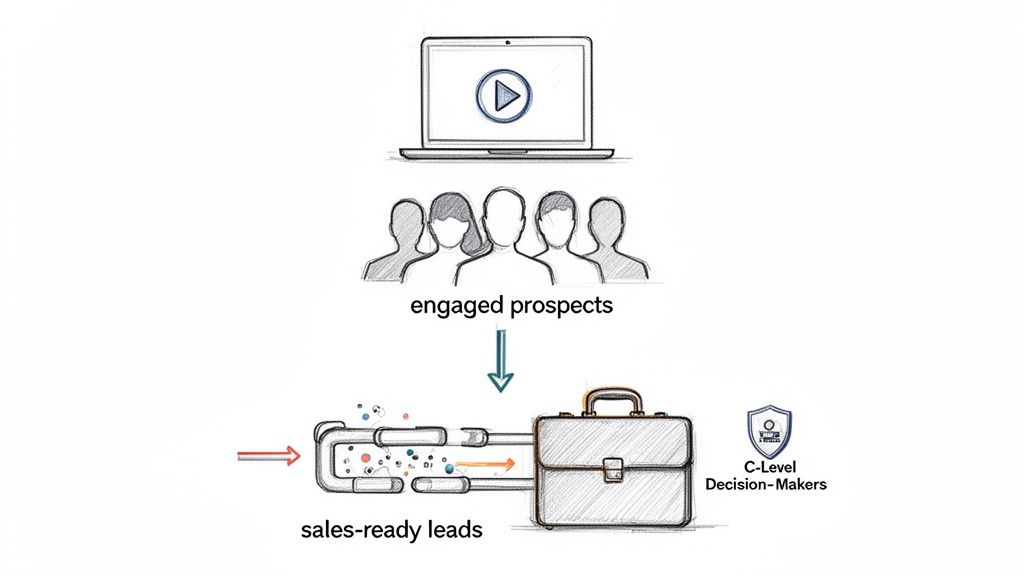
Unlike a static white paper or blog post, a webinar facilitates a dynamic, two-way conversation. It’s an opportunity to address specific pain points, answer technical questions in real-time, and demonstrate precisely how your platform provides value, all within a controlled, professional setting. This aligns perfectly with the modern B2B buyer’s journey, where self-education is a critical first step before engaging with a sales team.
Engaging High-Intent Prospects at Scale
The simple act of an individual registering for and attending your webinar is a powerful signal of intent. These are not passive scrollers on LinkedIn; they are professionals dedicating an hour of their schedule to learn about a topic directly tied to your solution. This addresses a core pain point for marketing teams: generating a consistent flow of high-quality leads amidst limited resources.
Consider a fintech SaaS firm hosting a webinar on automating new compliance regulations. The attendees are not merely curious. They are likely C-level executives and senior managers actively searching for a technological solution to a pressing business challenge. The leads generated are therefore significantly more valuable than those from a broad, top-of-funnel campaign. This is a cornerstone of any effective B2B demand generation strategy—you're not just capturing contacts, you're creating genuine demand for your solution.
Webinars provide a unique opportunity to educate an audience and build authority simultaneously. By delivering genuine value instead of a hard sell, you build the trust required to qualify prospects who begin to view your company as a credible strategic partner.
Proving Clear, Tangible ROI
For marketing leaders constantly required to demonstrate their impact on revenue, lead generation webinars deliver refreshingly clear metrics. This is not anecdotal; the data provides a compelling business case. The webinar and virtual event market is a powerhouse for lead generation, projected to reach US Dollars 4.44 billion by 2025.
What is fuelling this growth? Tangible, data-driven results. An impressive 73% of B2B marketers state that webinars are one of the most effective methods for generating high-quality leads. They offer a predictable and cost-effective strategy for filling the sales pipeline, directly addressing the pain points of tight budgets and the relentless need for quality content output. By positioning your internal experts as thought leaders, you create a powerful asset that not only generates leads today but also cements your brand’s authority for the long term.
Engineering a High-Conversion Webinar from the Ground Up
A successful webinar is engineered for results long before the 'record' button is pressed. This pre-production phase is where the strategic groundwork is laid to transform a simple presentation into a high-conversion event that captures qualified leads. It requires a deliberate, data-informed approach, from topic selection to the number of fields on your registration form.
The process begins with a fundamental question: what does our audience actually need to learn? Resist the temptation to host a generic, product-focused demonstration. Instead, leverage the most valuable source of customer intelligence you have: your sales and customer success teams.
Uncovering Webinar Topics That Convert
Your front-line teams possess a goldmine of content ideas. They interact daily with prospects and customers, hearing their unfiltered challenges, objections, and strategic goals. This insight is critical for developing content that resonates and converts.
Implementation Step: Organise a 30-minute workshop with your sales and customer success teams with a clear agenda.
Ask targeted, pain-point-oriented questions:
- What are the top three technical or strategic questions you receive on sales calls?
- Which platform features generate the most "how-to" questions?
- What industry challenges are our ideal customers most concerned about right now?
The answers will point you directly to topics with built-in demand. For instance, instead of a bland "Our Platform Features" webinar, you might discover that prospects consistently struggle with manual reporting. This insight allows you to frame a much more compelling event: “Automating Your Q4 Reporting: A Framework for Eliminating Manual Workflows.” This simple shift in focus from what you sell to the problems you solve is infinitely more attractive to a B2B SaaS audience.
Building Your Ideal Attendee Persona
With a pain-point-driven topic secured, you must define precisely who you are speaking to. A detailed attendee persona serves as the blueprint for all your content, ensuring every slide, talking point, and poll question is relevant and impactful.
This extends far beyond basic demographics. You need to capture the professional reality of your target attendee.
For example, a persona for a SaaS Marketing Director might look like this:
- Primary Goal: Prove marketing's contribution to revenue.
- Biggest Challenge: Limited resources and constant pressure to deliver high-quality content that generates leads.
- Key Metrics: Cost Per Lead (CPL), MQL-to-SQL conversion rate, pipeline influence.
- Content Preference: Actionable frameworks and data-backed case studies, not high-level theory.
With this level of detail, you can tailor your webinar's tone, language, and examples to speak directly to their professional world. This focus makes the content feel personally relevant and significantly more valuable.
A great webinar shouldn't just present information; it should make the attendee feel understood. Building your content around a detailed persona creates a connection that generic, one-size-fits-all content simply can't match.
Crafting a Frictionless Gating Strategy
Your registration page is a critical conversion point. Your gating strategy—how much information you request—is a delicate balance between data acquisition and user experience. You need sufficient data for lead qualification without creating so much friction that potential attendees abandon the form.
A simple form asking only for a name and email will maximise registrations, but the lead quality may be inconsistent. Conversely, a detailed form requesting company size, job title, and specific challenges provides rich data for sales but will likely deter some prospects.
The optimal strategy depends on your objective. For a top-of-funnel, broad-appeal webinar, a minimalist form is generally best. For a bottom-of-funnel, product-focused demo, a more detailed form helps pre-qualify attendees. The golden rule is to only request information you will actually use to personalise the follow-up.
To execute this effectively, choosing one of the best virtual event platforms is essential, as many offer customisable forms to support your chosen strategy.
A Multi-Channel Promotional Plan to Maximise Attendance
A perfectly crafted webinar is a wasted investment if no one attends. To transform your virtual event into a demand generation success, you need a disciplined, multi-channel promotional strategy that builds anticipation and secures registrations from your ideal prospects. This is not about simply blasting your email list; it's about delivering the right message, on the right channel, at the right time.
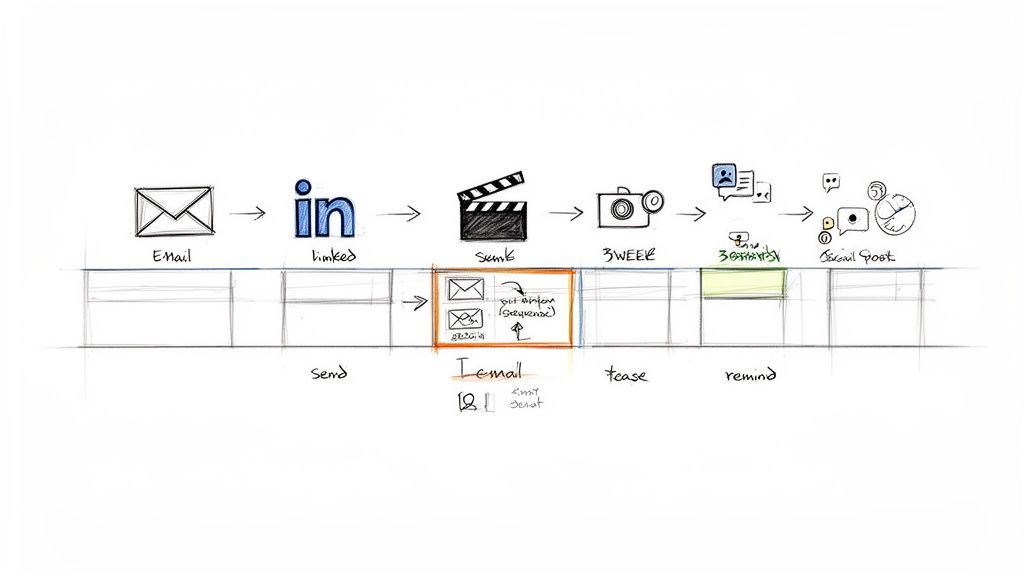
The optimal time to begin promotion is approximately three weeks before the live date. This provides sufficient time to build momentum without causing audience fatigue. The entire campaign should be built around a single, powerful premise: you are not selling an event, you are selling an outcome. Every piece of copy must reinforce the valuable, actionable knowledge attendees will gain.
Your Email Promotion Sequence
Despite the rise of social media, email remains the undisputed champion for driving webinar registrations. Data shows that 91% of B2B marketers cite email as their top-performing channel for this purpose.
Timing is critical. Our analysis shows that emails sent on a Tuesday between 9 am and 12 pm consistently achieve the highest engagement. The final promotional push is also crucial, with 54% of all registrations typically occurring in the week leading up to the event.
Your email sequence should be an orchestrated narrative that builds urgency and reinforces value.
- Email 1 (3 weeks out): The Announcement. This is your opening. Introduce the topic and speakers, focusing heavily on the primary pain point the webinar will solve.
- Email 2 (2 weeks out): The Value Deep-Dive. Share a key statistic or a compelling talking point from the presentation. Frame it as a teaser of the deeper insights to come.
- Email 3 (1 week out): The 'Last Chance'. Increase the urgency. Use subject lines like "Are you joining us next week?" and reiterate the core benefit they’ll miss out on.
- Email 4 (Day before): The Final Nudge. Keep it short and direct. This is a quick reminder for those still undecided, highlighting the live Q&A as a key benefit.
- Email 5 (Morning of): The Go-Live Alert. Sent only to registrants, this provides the final access link and builds anticipation.
Using LinkedIn for Targeted Outreach
LinkedIn is a precision tool for reaching your ideal attendee. Your strategy should encompass two distinct elements: public promotion and targeted, personal outreach.
First, create promotional assets specifically for LinkedIn. Instead of a static graphic, have your speaker record a 30-second video teaser sharing one provocative question the webinar will answer. This generates genuine intrigue and showcases their expertise.
Second, engage in relevant industry groups. Do not simply drop a link. Start a conversation related to your webinar topic. For example, if your webinar is about financial compliance, post in a CFO networking group: "How is everyone preparing for the upcoming [specific regulation] changes?" This positions you as a peer and allows you to introduce your webinar as a valuable resource organically.
The most effective webinar promotion feels less like marketing and more like a valuable, personal invitation. When you focus on the problem you're solving and the expertise you're sharing, you create genuine interest that converts far better than any generic sales pitch.
A Cohesive Cross-Channel Calendar
To execute this successfully, you need a coordinated plan. Your email sends, LinkedIn posts, and any partner promotions should work in harmony.
Here is a typical timeline to structure your promotional efforts.
Optimal Webinar Promotion Timeline and Channels
| Timeframe | Key Channels | Action Items and Content Focus |
|---|---|---|
| 3 Weeks Out | Email, LinkedIn (Organic) | - Announce the webinar to your email list. - Create a LinkedIn event page. - Speaker and company posts on LinkedIn focusing on the "why." |
| 2 Weeks Out | Email, LinkedIn (Organic & Groups) | - "Deep dive" email with a key insight or statistic. - Share a short video clip of the speaker on LinkedIn. - Start conversations in relevant LinkedIn groups. |
| 1 Week Out | Email, LinkedIn, Partner Channels | - "Last chance" email to drive urgency. - Daily LinkedIn posts counting down to the event. - Activate any promotional partners to share with their audience. |
| Week Of Event | Email, LinkedIn | - "Day before" reminder email. - "Morning of" reminder email (registrants only). - Final LinkedIn post highlighting the "going live soon" message. |
This schedule provides a solid foundation for efficiency gains, which is crucial for resource-constrained teams. For a more granular breakdown, you can explore a detailed framework to increase webinar attendance that outlines a week-by-week plan.
Remember, every touchpoint is a chance to communicate the value exchange. Your audience is giving you their time; in return, you must arm them with the knowledge to solve a critical business challenge.
Nailing Production: Achieving Professional Quality Standards
The technical quality of a webinar is a direct reflection of your brand. A pixelated video or distorted audio can instantly undermine your credibility, regardless of the content's brilliance. Achieving a broadcast-quality standard is more attainable than many believe, even without a significant budget.
A critical initial decision is whether to broadcast live or pre-record your session. Live events offer an element of immediacy but come with inherent risks, from unstable internet connections to speaker miscues. For an audience that expects professional polish, these risks can be substantial.
This is why, for most B2B SaaS companies, pre-recording is the strategically sound choice. It provides complete control over the final product. You can edit out errors, add polished graphics, and secure compliance approval well in advance. This approach removes day-of stress for your subject matter experts and ensures the final asset is flawless, maximising its long-term ROI.
Live vs. Pre-Recorded: A Strategic Decision
This choice dictates your entire production workflow and follow-up strategy. While a pre-recorded session can be highly engaging (e.g., through a live chat with a moderator), the production process is fundamentally different.
Here is a breakdown to inform your decision:
| Feature | Live Webinar | Pre-recorded Webinar |
|---|---|---|
| Quality Control | Lower; subject to real-time errors, internet glitches, and speaker slip-ups. | Highest; allows for retakes, professional editing, and a polished final product. |
| Speaker Stress | High; the pressure to perform perfectly in one take is immense. | Low; speakers can record their parts when relaxed and prepared. |
| Compliance | Risky; content is broadcast live without prior review. | Simple; the finished video can undergo full legal or compliance review before release. |
| Engagement | Perceived as higher due to live Q&A, but this can be replicated with a live moderator. | Can feel equally interactive with a live chat moderator and well-timed polls. |
| ROI & Efficiency | Lower; it's a one-off event with a limited shelf life unless the recording is perfect. | Higher; you create a perfect, evergreen asset for lead generation that works for you 24/7. |
For marketing teams focused on efficiency and maximising the value of every content piece, the pre-recorded route consistently delivers a superior, risk-free asset.
Achieving a Broadcast-Quality Look and Feel
A professional appearance does not require a film studio. A few modest, strategic investments can dramatically elevate your production quality. Focus on three key areas: lighting, audio, and background.
Crisp Audio is Non-Negotiable: Your audience will forgive a slightly soft video, but they will not tolerate muffled or distorted audio. The most critical piece of equipment is a quality external USB microphone for each speaker. A reliable model costs between US Dollars 70 and US Dollars 150 and provides a significant improvement in audio clarity.
Good Lighting Conveys Professionalism: Avoid relying on standard overhead room lighting, which creates unflattering shadows. A simple three-point lighting setup with affordable LED panels, or even a single ring light, will ensure your speaker is clear, bright, and professional.
Maintain a Clean and Uncluttered Background: The speaker’s environment should not be a distraction. A tidy office, a branded backdrop, or a tastefully blurred digital background are all effective options. The goal is to keep the focus entirely on the speaker and their message.
The gold standard for webinar production is not about expensive equipment; it is about intentionality. A well-placed light and a clear microphone will always outperform a high-end camera in a poorly lit room.
Mastering these fundamentals ensures your presentation reflects the quality of your brand. For a deeper dive, explore our top tips for effective webinar production. With Cloud Present, our team manages all technical direction, allowing your experts to focus solely on sharing their knowledge, confident they will look and sound their best.
The Content Repurposing Flywheel: Maximising Your Investment
The live webinar broadcast is just the beginning. For B2B SaaS marketers juggling tight resources and the constant demand for more content, the true ROI of a webinar is realised long after the event concludes. The ‘Content Repurposing Flywheel’ is a practical system for transforming one 60-minute session into a month's worth of strategic marketing assets, addressing the pain point of consistent content output.
Think of it as a content engine. Instead of constantly starting from a blank page, you systematically deconstruct the original webinar into smaller, more digestible pieces of content. These assets can then fuel every marketing channel, from your LinkedIn feed to your lead nurturing sequences, creating significant efficiency gains.
From a Single Webinar to a Full Content Calendar
The core concept is to extract maximum value from your expert's time and your production budget. A single insightful comment from a speaker can become a compelling LinkedIn quote graphic. A complex data point shared on a slide can form the basis of a detailed infographic or a short-form blog post.
This strategy is not just about efficiency; it’s about meeting your audience where they are with formats they prefer to consume. Not everyone has an hour for a full replay, but they are likely to watch a 60-second video clip on their social feed or download a practical checklist.
Before repurposing, however, you need a high-quality core asset. This simple workflow outlines the essential production steps.
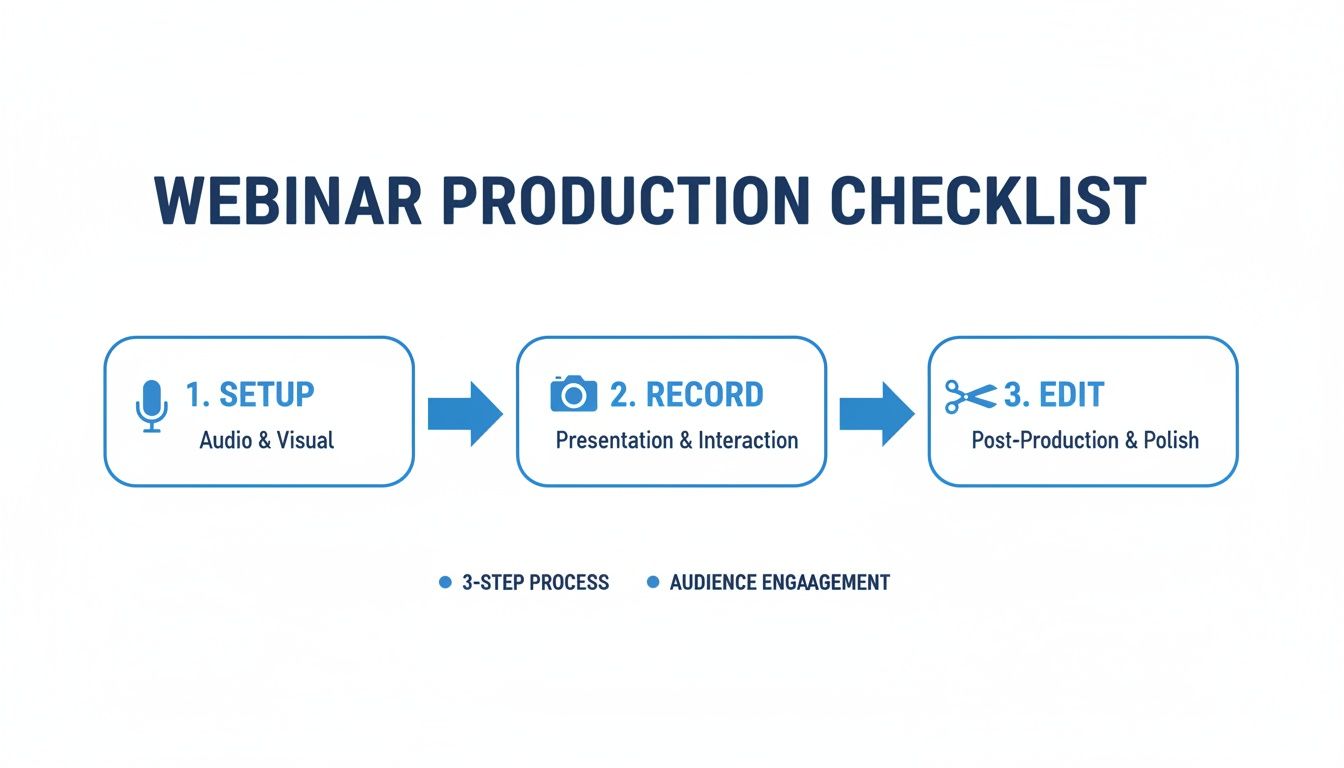
Nailing this process provides a polished recording—the raw material for effective content repurposing.
Your Tactical Plan: Turning One Webinar into 10+ Assets
How do you strategically slice and dice your core webinar recording into over ten distinct assets? The matrix below provides a practical guide, outlining what you can create, its strategic purpose, and its primary distribution channel.
Webinar Content Repurposing Matrix
This matrix serves as your blueprint for transforming a single webinar into a full-funnel content campaign. Each format is designed to capture attention and drive action across different platforms.
| Original Asset | Repurposed Format | Strategic Purpose | Primary Channel |
|---|---|---|---|
| Full Webinar Recording | On-Demand Gated Replay | Evergreen lead generation for those who missed the live event. | Dedicated Landing Page |
| Full Webinar Recording | Comprehensive Blog Post | SEO authority, deep-dives on key topics, embedding video clips. | Company Blog, SEO |
| Webinar Transcript | Downloadable PDF Guide | High-value lead magnet for nurturing existing contacts. | Email Nurture, Blog CTA |
| Key Speaker Moments | Short-Form Video Clips (30-90s) | High-engagement, scroll-stopping content to drive awareness. | LinkedIn, YouTube Shorts, X |
| Speaker Quotes | Designed Quote Graphics | Reinforce thought leadership and boost social media shares. | LinkedIn, Instagram, X |
| Audio Track | Animated Audiograms | Share audio insights on visual-first platforms. | LinkedIn, Instagram |
| Full Slide Deck | SlideShare Presentation | Expose content to a new professional audience, sales enablement. | SlideShare, Sales Outreach |
| Core Concepts | Infographic | Visually simplify complex data for easy sharing and recall. | Blog, Social Media, Email |
| Q&A Session | "Answering Your Questions" Post | Address common pain points and demonstrate expertise. | Blog, LinkedIn |
| Core Webinar Content | Email Nurture Sequence | Educate and guide leads down the funnel with bite-sized insights. | Marketing Automation Platform |
By following this framework, you build a library of assets that work in concert to attract, engage, and convert your target audience long after the webinar is over.
The real power of lead generation webinars lies in their longevity. Top-performing formats can achieve conversion rates between 20% and 40% of attendees into actionable leads, and with 63% of views coming from on-demand versions, the lead generation value extends far beyond the live date. You can read more about the long-term impact of webinar content on Embryo.com.
At Cloud Present, our entire service is built around this flywheel concept. We don’t just produce a webinar; as your strategic partner, we deliver a complete package of repurposed assets. We handle the editing, design, and formatting, enabling your team to focus on strategy and distribution. This turns every webinar from a one-off event into a continuous, pipeline-filling campaign.
Measuring Webinar Success and Proving ROI
If you cannot measure your lead generation webinars, you cannot improve them or justify the investment. For B2B SaaS marketers under constant pressure to prove their value, moving beyond vanity metrics is non-negotiable. This final phase is about translating your efforts into a clear, compelling story of return on investment (ROI).
Forget fixating on registration counts. While a high number of sign-ups feels positive, it is a soft metric that reveals little about business impact. True success lies in tracking the metrics that matter to your C-suite and your sales team.
Shifting Focus to Actionable KPIs
To demonstrate the real value of your webinar programme, you must connect your marketing activities directly to sales outcomes. This means shifting your focus from broad engagement numbers to concrete conversion points.
Here are the core metrics you should be tracking:
- Attendee-to-MQL Conversion Rate: This is the gold standard. It measures the percentage of live attendees who become Marketing Qualified Leads (MQLs) based on engagement and ICP fit. A strong rate here (aim for 20% or higher) proves your content is attracting the right audience.
- Cost Per MQL: Calculate this by dividing your total webinar cost (platform fees, promotional spend, speaker fees) by the number of MQLs generated. This provides a hard metric to compare against other marketing channels.
- Pipeline Influence: This is crucial. It tracks how many sales opportunities were touched by the webinar. If a prospect attended your event and then requested a demo a week later, your webinar influenced that deal.
- Lead Velocity Rate: Did the webinar accelerate the journey for existing leads? Track how quickly leads who attended move to the next stage in your sales funnel compared to those who did not.
Implementation Step: Ensure tight integration between your webinar platform, marketing automation system (e.g., HubSpot, Marketo), and CRM (e.g., Salesforce). The goal is to create a seamless data trail that follows a prospect from registration to contract.
The most powerful conversation you can have with stakeholders is one backed by data. When you can state, "Our last webinar generated 50 MQLs at a cost of US Dollars 100 each, and has already influenced US Dollars 75,000 in the sales pipeline," you are no longer just talking about marketing; you are talking about revenue.
Building a Simple ROI Model
You do not need a complex financial model to prove your point. A straightforward calculation can paint a clear picture of the financial return.
Let's walk through a practical example. Assume your webinar has the following costs:
- Production & Platform Costs: US Dollars 2,500
- Promotional Spend (LinkedIn Ads, etc.): US Dollars 2,500
- Total Investment: US Dollars 5,000
Now, let's analyse the return from that investment:
- Total Live Attendees: 250
- Attendee-to-MQL Conversion Rate: 20%
- Total MQLs Generated: 50 (250 x 0.20)
- Cost Per MQL: US Dollars 100 (US Dollars 5,000 / 50)
If your sales team typically converts MQLs into qualified sales opportunities at a rate of 10%, that webinar has created 5 new sales opportunities. If your average deal size is US Dollars 15,000, you have just added US Dollars 75,000 in potential revenue to the sales pipeline from a single event.
This simple model provides the language and data for a strategic conversation about budget and impact. It transforms your webinar programme from a "cost centre" into a predictable and scalable revenue driver. To truly understand the full impact, it helps to delve deeper into proven strategies for measuring marketing ROI that can strengthen your business case even further.
By consistently tracking these metrics and presenting them in a clear, business-focused manner, you not only justify your current activities but also build an undeniable case for scaling your webinar efforts.
At Cloud Present, we are a strategic partner dedicated to helping you prove the value of your virtual events. Our integrated analytics dashboard simplifies the tracking of metrics that matter, providing the insights needed to demonstrate ROI and make data-driven decisions. Discover how we can help you turn every webinar into a measurable success at https://www.cloudpresent.co.


