A Guide to Webinar Production Services for B2B SaaS Growth
Discover how professional webinar production services drive ROI and efficiency. This guide covers the workflow, benefits, and how to choose the right partner.

Webinar production services are your dedicated, on-demand virtual event team. A specialist partner manages the entire webinar lifecycle—from strategic planning and professional recording to post-production polish, branding, and content repurposing. This frees your marketing and content teams to focus on what drives revenue: delivering expert insights and engaging your audience, not wrestling with technology.
Why Webinar Production Services Are a Strategic Move for SaaS
For B2B SaaS marketing and content teams, the pressure to produce a consistent stream of high-calibre content is relentless. Webinars remain a powerful tool for demand generation, but the in-house effort required to produce them to a professional standard can drain your limited resources. This is where partnering with a specialist for webinar production services stops being a cost and becomes a strategic investment in efficiency, quality, and measurable ROI.
Imagine your top product marketers or solutions engineers focusing solely on delivering compelling insights that solve customer pain points. Behind the scenes, a production partner handles all the technical heavy lifting, ensuring every recording is polished, on-brand, and engineered to generate qualified leads.
Overcoming the In-House Production Bottleneck
Many SaaS teams attempt to juggle webinar production internally, leading to common pain points that kill ROI: inconsistent audio/video quality, missed deadlines due to stretched resources, and valuable content that is never repurposed. The result? A single, underperforming video instead of a powerful content engine that fuels your demand generation funnel. An in-house approach often results in a 50% higher time investment from your marketing team compared to outsourcing.
An outsourced partner breaks these bottlenecks. By implementing a proven, streamlined workflow, they can turn around a fully edited and branded webinar in just 3-5 business days—a velocity most internal teams cannot match. This agility is critical for launching product updates, responding to competitor moves, or addressing timely market trends.
A Growing Market Demands Professionalism
The shift towards sophisticated virtual and hybrid events is a significant economic trend. The UK events industry, including webinars, reached a valuation of £61.65 billion in 2023. Business events contributed £33.6 billion, with conferences and meetings accounting for £16.3 billion. This growth underscores the rising expectations of B2B audiences. Professional production is no longer a "nice-to-have"; it’s essential to cut through the noise and demonstrate your brand's authority. You can find out more about the UK business events sector growth.
A professional webinar production service transforms a one-off event into an evergreen, lead-generating asset. By shifting to a pre-recorded format, you gain complete control over quality and messaging before it reaches your audience, boosting engagement rates by an average of 20%.
This strategic shift from live-only events to polished, pre-recorded assets provides the quality control necessary to succeed. It allows for meticulous editing, the addition of on-brand motion graphics, and ensures every piece of content works harder to build your authority and generate MQLs.
Comparing In-House and Outsourced Webinar Production
Deciding whether to keep webinar production in-house or partner with a service is a classic "build versus buy" dilemma. While an internal approach may seem to offer more control, it often introduces hidden costs and drains resources. Outsourcing provides specialist expertise and speed that is difficult to replicate, leading to significant efficiency gains.
Here's a practical comparison for a B2B SaaS team:
| Aspect | In-House Production | Outsourced Production Service |
|---|---|---|
| Resources & Expertise | Relies on marketing generalists who may lack specialist video/audio skills. Requires ongoing investment in software licences (e.g., Adobe Creative Suite, Descript). | Access to a dedicated team of experienced producers and editors. No capital expenditure on gear or software. |
| Speed & Turnaround | Often slow, with production timelines stretching for weeks due to competing priorities and limited capacity, delaying campaign launches. | Fast and reliable. Delivers polished, ready-to-publish assets in days (3-5 business days is standard), accelerating your content pipeline. |
| Quality & Consistency | Quality can be inconsistent, depending on who is available. Branding may vary between projects, diluting brand identity. | Guarantees a professional, broadcast-quality finish every time. Ensures strict adherence to brand guidelines for a cohesive customer experience. |
| Strategic Focus | Pulls marketing managers and product experts away from their core roles (e.g., campaign strategy, product development) to manage technical tasks. | Frees up your internal experts to focus on creating high-value content and strategy, maximising their impact on business goals. |
For SaaS companies that need to produce high-quality content at a consistent pace to fuel their growth engine, partnering with a production service is the most efficient and effective path to achieving a higher content ROI.
Ready to see how a streamlined production process can elevate your content strategy? Explore Cloud Present's end-to-end service designed for ambitious B2B SaaS teams.
Deconstructing the End-to-End Production Workflow
Behind every webinar that drives qualified leads and feels effortless to watch, there is a deliberate, meticulously planned production workflow. For B2B SaaS marketing teams, understanding this process reveals the true value of a specialist partner. It’s not just about hitting ‘record’; it’s a strategic journey that transforms an expert's knowledge into a powerful, evergreen content engine.
A robust workflow ensures nothing is left to chance. It's the difference between a forgettable online meeting and a high-impact marketing asset that delivers sustained value. Let's pull back the curtain on the seven critical stages a professional webinar production service will manage for you.
Stage 1: Strategic Planning and Content Workshops
The best webinars start with a clear strategy. This initial phase involves a collaborative workshop to align the webinar’s purpose with your broader marketing objectives. For instance, is the goal to generate top-of-funnel MQLs (Marketing Qualified Leads) with a thought leadership piece, or is it a bottom-of-funnel product demo designed to accelerate sales cycles?
Key implementation steps in this stage include:
- Defining the target ICP (Ideal Customer Profile) to ensure content resonates with their specific pain points.
- Mapping the topic to a specific funnel stage—awareness (e.g., "The Future of AI in Marketing"), consideration (e.g., "A Deep Dive into Our Platform's Analytics"), or decision (e.g., "Customer Story: How Company X Achieved 150% ROI").
- Setting clear KPIs, such as aiming for a 45% registration-to-attendee conversion rate and a target of 100 new MQLs.
Stage 2: Seamless Speaker Onboarding and Tech Checks
Your subject matter experts are the stars, but they don't need to be tech wizards. A smooth onboarding process is vital for building their confidence and ensuring pristine recording quality. This involves providing clear briefing documents, scheduling pre-flight tech checks, and ensuring they are comfortable in their recording environment.
A production partner manages this entire process, offering one-on-one support to validate that audio and video meet professional standards before recording begins. This proactive step prevents the technical issues that frequently derail in-house productions.
Stage 3: Professional Recording and Capture
This is where the content is captured. Using a browser-based recording studio, a production partner captures high-fidelity audio and video locally from each speaker. A critical part of the end-to-end production workflow is successfully recording a webinar with stable, high-quality inputs, a method far superior to standard meeting software that compresses video and is susceptible to internet instability.
The pre-recorded format provides a crucial safety net. It eliminates the risk of live technical failures, allows speakers to re-record sections for clarity, and provides a raw asset that is perfectly primed for post-production excellence.
Stage 4: Post-Production Polish and Branding
Raw footage is merely the starting point. The post-production phase transforms it into a polished, on-brand asset. For most in-house teams, this is a major resource drain; for a production service, it’s a core competency.
This stage typically includes:
- Editing for Flow: Removing filler words ("ums," "ahs"), mistakes, and awkward pauses to create a tight, engaging narrative. A 45-minute recording can often be tightened to a more impactful 35-minute asset.
- Audio Sweetening: Balancing levels and eliminating background noise for a crisp, professional sound.
- Branding: Adding your custom-branded intros, lower thirds, motion graphics, and video overlays to reinforce your brand identity.
- Transcription: Creating a word-for-word transcript, which is essential for accessibility and content repurposing.
For many teams, a rapid turnaround is critical. Curious about how fast this can be? Check out our guide on the 3-day webinar production timeline.
Stage 5: Strategic On-Demand Distribution
With a polished webinar ready, the next step is distributing it effectively. A production partner helps implement an on-demand strategy. A common implementation step is hosting the video on a branded landing page behind a lead-capture form integrated with your marketing automation platform (e.g., HubSpot, Marketo) to trigger an automated email nurture sequence. The goal is to make the asset work for you 24/7, generating leads long after the recording is finished.
Stage 6: Powerful Content Repurposing
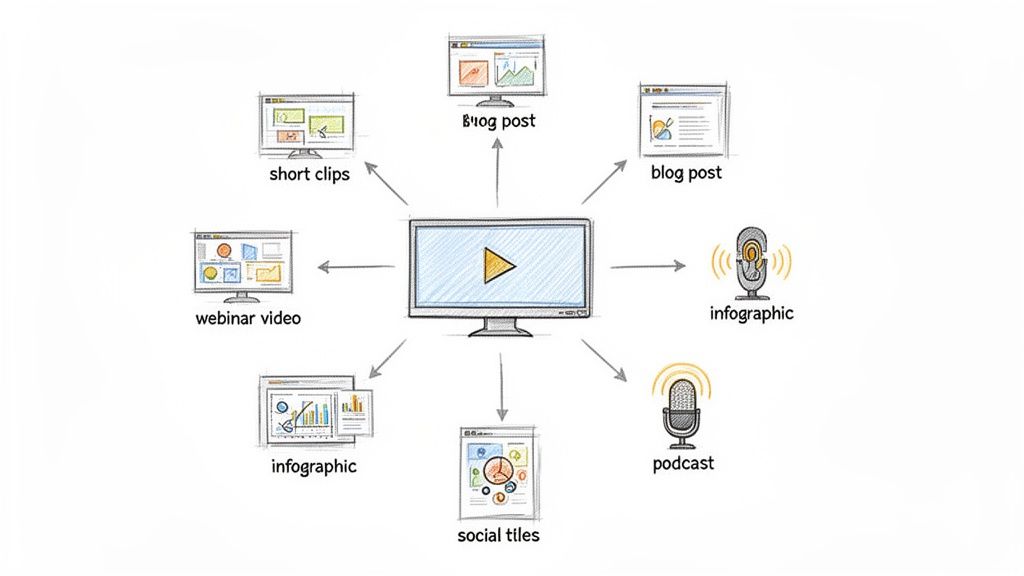
This is where the ROI truly multiplies. A single 45-minute webinar is a content goldmine. A production partner will systematically deconstruct the primary asset into a suite of micro-content tailored for different channels, turning one effort into over ten marketing assets.
For example, one webinar can become:
- Three to five short video clips (30-60 seconds) perfect for sharing key insights on LinkedIn, driving an average 5x higher engagement than static posts.
- A detailed summary blog post optimised for search engines to capture organic traffic.
- An audiogram to promote the content on social media channels.
- A series of quote graphics featuring powerful statements from your speaker to use on social media.
Stage 7: Performance Analytics and ROI Tracking
Finally, data is needed to prove value and refine future strategy. A production partner will help you track the metrics that matter, often presenting insights in a clear dashboard. This involves analysing view duration, identifying audience engagement drop-off points, and tracking lead conversion rates from your gated content. This data closes the loop, demonstrating the direct impact of your webinar programme on the business's pipeline and revenue.
The Core Benefits for B2B SaaS Companies
For any B2B SaaS company, every piece of content must reinforce authority and build trust. Partnering with a specialist for webinar production services delivers more than just a polished video; it provides a strategic asset that drives demand, ensures brand consistency, and frees up your most valuable people.
This isn't just about outsourcing a task; it's about solving the biggest pain points for SaaS marketing teams: the need for speed without sacrificing quality, the relentless pressure to generate leads, and the constant battle for internal resources. Let's break down the four pillars of value you can expect.
Speed and Agility
In the fast-paced SaaS world, timing is everything. A new feature is launched, a competitor makes a move, or a market trend emerges, and you need to respond with insightful content. An outsourced production partner can turn around a fully polished, branded, and transcribed webinar in just 3–5 business days. This agility provides a massive competitive edge, allowing you to publish crucial insights while others are still in the planning stages.
For a B2B SaaS company, a webinar is a product showcase and a brand statement. Outsourcing ensures it meets the same high standards as your software, protecting your reputation and accelerating the sales cycle.
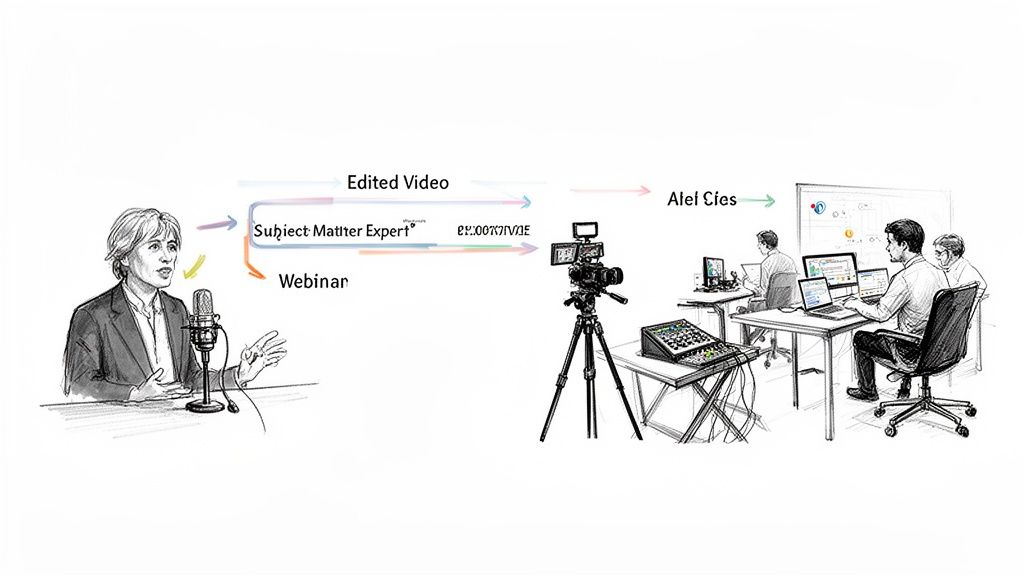
This simple workflow makes speed and control possible.
It’s a streamlined process that moves from planning to professional recording and on-demand distribution, creating a repeatable system for high-quality content, every time.
On-Brand Professionalism
Your company’s reputation is its most valuable asset. A DIY webinar with poor audio, sloppy editing, or generic branding can actively damage it. Professional production instantly elevates you beyond the inconsistent quality of standard video conferencing tools.
This means:
- Broadcast-Quality Audio and Video: High-fidelity local recording technology is used to make every speaker sound crisp and clear, completely independent of their internet connection.
- Custom Branding: Your logo, colours, and fonts are integrated seamlessly. Think custom intros, lower thirds, and slide decks that create a cohesive, professional brand experience.
- Polished Editing: All "ums," awkward pauses, and technical glitches are removed. The result is a tight, engaging narrative that respects your audience's time and holds their attention, increasing average view duration by up to 40%.
This level of polish isn't just cosmetic. It’s a powerful signal of quality that reinforces the premium nature of your software and services.
Sustainable Lead Generation
A live event is impactful, but its reach is finite. A professionally produced, pre-recorded webinar becomes an evergreen lead generation machine. By placing the on-demand recording behind a simple form on your website, you create a content engine that works for you 24/7.
This strategy turns your team's expertise into a reliable source of Marketing Qualified Leads (MQLs). One great webinar on a critical topic can attract qualified prospects for months, or even years, delivering a significantly higher ROI than any one-off live session. Data shows that 73% of B2B webinar attendees become qualified leads, proving the format's power when executed professionally.
Resource Efficiency and ROI
Finally, consider the true internal cost. How many hours do your marketing managers, content creators, and subject matter experts really spend on logistical and technical tasks for each webinar? The total cost of ownership for DIY production, including salaries and lost opportunity, often exceeds the cost of outsourcing by 30-40%.
Outsourcing allows you to redirect those hours from low-value technical administration to high-value strategic work. Instead of troubleshooting audio, your marketing team can focus on promotion and lead nurturing. Instead of worrying about lighting, your product experts can focus on delivering world-class insights. This efficiency gain translates directly into a higher ROI because your best people are focused on what they do best.
Ready to see how a professional service can transform your content strategy? Explore how Cloud Present delivers broadcast-quality webinars in days, not weeks.
Your Content Repurposing Playbook
A polished, professionally produced webinar isn't a one-off marketing event. It's the cornerstone of an entire content campaign. For busy B2B SaaS marketing teams, this is where the return on investment truly explodes. Instead of constantly brainstorming new ideas from scratch, you can systematically break down a single high-value webinar into more than ten distinct pieces of content. This provides weeks of fuel for your marketing channels, all from one recording session.
This approach solves a major pain point for content teams: the relentless pressure to produce a consistent stream of fresh, high-quality material. By treating each webinar as a content pillar, you build a sustainable engine for demand generation. It’s about working smarter, not harder, to maximise the value of your experts' time and insights.
Let's walk through a practical playbook for turning one recording into a multi-channel campaign.
The Core Asset: The Full-Length On-Demand Webinar
First, the original, polished webinar recording becomes your cornerstone asset. It should be hosted on a dedicated landing page behind a simple lead-capture form, turning it into an evergreen lead magnet. This is your highest-value piece, perfect for prospects in the consideration phase who are actively researching solutions.
- Implementation Step: Gate the video on a landing page with a form that asks for name, company, and email. Integrate this form with your marketing automation platform to add leads to a specific nurture track.
- Target Audience: Prospects actively evaluating solutions.
- Call-to-Action (CTA): "Watch the full webinar to learn how to [achieve specific outcome]."
Creating High-Impact Micro-Video Clips
Next, your webinar production services partner can identify the most powerful moments from the recording—key insights, data points, or impactful quotes—and edit them into short, snappy video clips. The optimal output is three to five clips, each between 30 and 90 seconds long. These are perfect for capturing attention on social media.
Each clip must focus on a single compelling idea and include burned-in captions. This is non-negotiable, as 85% of social media videos are watched with the sound off.
- Implementation Step: Provide your production partner with timestamps of key moments you want to highlight. Use a tool like Veed.io or let your partner handle captioning.
- Target Audience: Top-of-funnel audience for building brand awareness.
- CTA: "Get more insights in our full webinar. Link in bio."
From Video to Written Content
The webinar transcript is a treasure trove for written content. A skilled writer can easily transform the key talking points into a comprehensive, 1,500-word blog post. This does more than just summarise the webinar; it captures valuable organic traffic from search engines for related keywords, extending your reach far beyond the original audience.
From that blog post, you can then extract key statistics or impactful quotes and turn them into eye-catching graphics for social media using a tool like Canva. These are highly shareable and reinforce your core messages.
By repurposing a single webinar, you create a cohesive, multi-touchpoint campaign. A prospect might see a video clip on LinkedIn, read the blog post a week later after a Google search, and finally convert on the full-length recording.
Audio and Visual Repurposing
Don't forget the audio. The full audio track can be effortlessly converted into a podcast episode, perfect for reaching audiences during their commute. You can also create shorter audiograms—a static image with an audio waveform and a compelling snippet—to promote the full episode on social media.
Finally, condense the most important data points or process flows into a clean, engaging infographic. Infographics are brilliant for making complex information digestible and are extremely shareable, helping you drive backlinks and build authority. To maximise your efforts, explore these effective content repurposing strategies.
Here’s a sample implementation plan showing how one webinar can fuel awareness, generate leads, and nurture prospects across the entire buyer's journey.
Sample Webinar Content Repurposing Plan
| Original Asset | Repurposed Asset Type | Target Channel | Marketing Goal (Awareness, Lead Gen, Nurture) |
|---|---|---|---|
| 60-Min Webinar | Full On-Demand Video | Website Landing Page | Lead Gen |
| 60-Min Webinar | 5 x 90-Sec Video Clips | LinkedIn, Twitter | Awareness |
| 60-Min Webinar | 1,500-Word Blog Post | Company Blog, SEO | Awareness, Lead Gen |
| 60-Min Webinar | Podcast Episode | Spotify, Apple Podcasts | Awareness, Nurture |
| 60-Min Webinar | Infographic | Blog, Pinterest, Social | Awareness |
| 60-Min Webinar | 3 x Quote Graphics | Instagram, LinkedIn | Awareness |
| 60-Min Webinar | Email Nurture Sequence | Email Marketing | Nurture |
By following a playbook like this, a single production effort with Cloud Present doesn't just give you a video—it delivers a full suite of assets designed to make a real impact on your pipeline.
How to Choose the Right Production Partner
Selecting the right partner for your webinar production services is more than hiring a vendor. You're seeking a strategic ally who understands your business goals, can integrate seamlessly with your marketing team, and handles all technical complexities while you focus on strategy.
Get it right, and they become a genuine extension of your team, amplifying your content output and improving quality. Get it wrong, and you face missed deadlines, inconsistent quality, and a frustrating drain on your resources.
To make the right decision, go deeper than a simple price comparison. Vet their capabilities, processes, and industry knowledge to ensure they can deliver the results your SaaS business needs. Use the following questions as a checklist to get past the sales pitch and find a true production partner.
Technical Capabilities and Quality Standards
The foundation of any great webinar is its technical execution. Your partner's technology stack and production standards directly impact the final quality, which reflects on your brand.
- Recording Platform: How do you capture video and audio? Do you use local recording to avoid issues with internet connectivity? (The correct answer is yes, as this ensures high-fidelity capture regardless of connection quality).
- Editing and Branding: Can I see examples of your post-production work? What are my options for custom branding, including animated intros, lower thirds, and custom backgrounds?
- Asset Delivery: In what formats will the final webinar and repurposed clips be delivered? Are transcripts and captions included as standard?
Process, Communication, and Turnaround Times
A smooth workflow is just as critical as the final product. A partner’s project management and communication style can be the difference between an efficient process and a logistical nightmare. Your goal is a team that makes your life easier.
Your production partner should feel like a part of your team, not another vendor to manage. Their process should be transparent, their communication proactive, and their deadlines reliable. This is the hallmark of a service designed for efficiency.
Key questions to ask:
- Can you walk me through your end-to-end production workflow? Have them map out a typical project, from the initial kick-off call to final asset delivery.
- What is your standard turnaround time for a polished webinar edit? For timely topics, a 3–5 business day turnaround should be the benchmark.
- Who will be my day-to-day contact, and how will we communicate? Look for clear communication channels (e.g., a shared Slack channel) and a dedicated project manager.
Industry Expertise and Strategic Input
This is crucial. A partner should understand the SaaS landscape, the importance of metrics like MQLs and pipeline influence, and the specific nuances of your audience. A generic video company won't understand the strategic importance of a bottom-of-funnel demo versus a top-of-funnel thought leadership piece.
Probe their experience with these questions:
- Have you worked with other B2B SaaS companies? Can you share relevant case studies or examples?
- How do you help align webinar content with specific marketing goals like lead generation or customer retention? A strategic partner will offer input, not just execute orders.
Pricing, ROI, and Reporting
Finally, discuss investment and measurement. You need to understand the cost structure and how your partner will help you track success. Avoid vague pricing; you want transparent models that align with the value you receive. The conversation should focus on return on investment.
- What do your pricing models look like? Is it per-project, a monthly retainer, or package-based? Are there extra costs for revisions or repurposing assets? A retainer model often provides the best value and consistency for teams needing a regular content cadence.
- How do you help measure and report on the success of a webinar programme? A true partner should help you track key metrics like lead conversion rates, audience engagement, and content performance to demonstrate ROI.
Making the right choice often comes down to weighing the pros and cons of outsourcing versus building this capability in-house. For a detailed breakdown, check out our guide on the real economics of professional webinar production. Armed with these questions, you can confidently find a partner who will help you scale your content, drive demand, and cement your company's position as a leader.
Frequently Asked Questions
When exploring webinar production services for the first time, a few common questions arise. Here are straightforward answers about costs, formats, and timelines.
How Much Do Webinar Production Services Typically Cost?
Pricing models generally fall into two categories. For a single webinar project, you can expect a per-project fee, typically ranging from US$2,000 to US$6,000. The final price depends on factors like editing complexity, the number of speakers, and, crucially, the number of repurposed assets required (e.g., video clips, blog posts).
Alternatively, a monthly retainer is ideal for SaaS teams needing a consistent content pipeline. This model provides predictable costs and typically includes a set number of webinars and repurposed assets each month. This approach fosters a more strategic, efficient workflow with your production partner, leading to better long-term results.
What Is the Difference Between a Pre-recorded and a Live Webinar?
A live webinar occurs in real-time, which can be engaging but also carries risks like technical failures or speaker errors. For B2B SaaS marketers, a pre-recorded webinar offers significant strategic advantages. The primary benefit is quality control. You can edit out any mistakes, awkward pauses, or tech glitches, resulting in a flawless final video that reflects the quality of your brand.
This format also accommodates the busy schedules of your subject matter experts, allowing them to record at their convenience. Pre-recording provides a polished, high-value asset that can be used for on-demand lead generation long after the initial broadcast.
How Long Does the Process Take from Planning to Final Assets?
This is where a specialist partner delivers significant efficiency gains. The entire process is surprisingly fast and predictable. Following a planning session and the recording by your experts, you can expect the fully edited and branded webinar back in just 3–5 business days.
This rapid turnaround allows you to react swiftly to market trends or product launch timelines. Following the delivery of the main webinar, the full suite of repurposed content—including short video clips, a summary blog post, and quote graphics—is typically delivered within another 5–7 business days. In less than two weeks, your team has an entire campaign's worth of content ready to deploy.
At Cloud Present, our mission is to eliminate the technical headaches and logistical chaos of webinar production. Our end-to-end service covers everything from initial strategy to final asset delivery. We empower your experts to focus on sharing their insights while we build a powerful content engine that fuels your company's growth.
Discover how our webinar production service can transform your content strategy.